

TORCH is a feminist conference by Total Woman Victory that aims to bring together women committed to rebuilding radical feminism as an independent, anti-imperialist political force. Held on October 9 - 11 in Worcester, Massachusetts—the site of the first National Woman’s Rights Convention of 1850—this gathering situates itself in a long tradition of feminist organizing outside state, NGO, academic, and empire-aligned institutions.
TORCH calls on women who recognize the decisive break between anti-imperialist feminism and feminism that serves empire to begin organizing independently. Through theory-building, getting organized, consciousness-raising, and historicizing contradictions, the conference aims to revive the foundational practices that once forged durable feminist movements. This is a space to form real political connections, clarify lines of struggle, and continue the unfinished revolutionary project of women’s liberation—because feminist revolution cannot be built alone, and the torches of our foremothers demand to be carried forward.
Thank you for joining us for TORCH 2026!
You can find out more about our programming, find resources for consciousness raising, and read our full statement on the events of October 9 - 11 below!
What does TORCH mean?

Cohesive frameworks for liberating women requires THEORY that analyzes the contradictions of the female sex class condition.

The future of female liberation rests in the assembly of feminist theorists who can ORGANIZE and lead a formal feminist political party.

There must be communication between feminists and members of the public who have not yet become radicalized by RAISING CONSCIOUSNESS.

By studying our HISTORY, feminists can discern what has not served our movement and what will sustain it.
TORCH 2026 Program
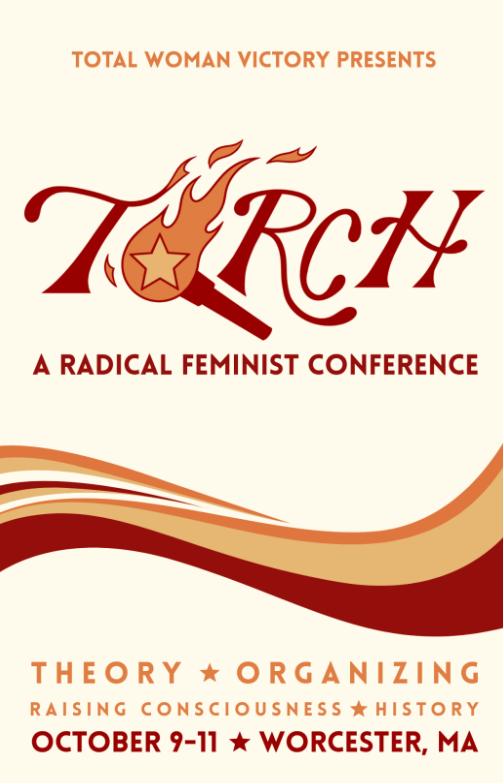
Click the image to download the program for TORCH 2026.
You can read about our conference schedule, panels and workshops, learn more about consciousness raising and our Freedom Trash Can event, and see all the amazing women who attended as speakers!
TORCH 2026 featured amazing sessions from our speakers:
How to Avoid Getting Derailed When Discussing the Abolition of Prostitution
Cherie Jiminez and Melissa Farley
Why is an Anticolonial Analysis Crucial to Feminism?
Melissa Farley, Joanna Hicks, and Taina Bien-Aimé
The Sexualization of Power: How Male Entitlement, Misogyny, and History Fuel Sex Trafficking & How We Stop It
Rights4Girls: Carolina Bazan
The Liberation Struggle as a Learning Process: Reflections from Two 1960s Movement Founders
Kathie Sarachild and Carol Hanisch
Birth Strike Consciousness, Feminist Organizing, and Struggling for Social Wage Gains as Weapons for Defending and Advancing Against Sexual Exploitation such as Prostitution, Sexist Violence, and Many Other Forms of Women's Oppression
Redstockings: Marisa Figuerido and Jennifer Sunderland
She Holds The Line: Black Women Speak on Gender Ideology - Author Discussion and Q&A
Nevline Nnaji and Khadijah La Musa
K-Pop Demon Hegemony: A Transnational Feminist Analysis
Boston AF3IRM: Joanna Hicks
Women's Liberation Completes the Revolution: Feminist Organizing and Building Power to Win
San Diego AF3IRM National Organizing Director: Roslyn Cassidy
Demystifying Epstein and His Brotherhood: Rich Subjugators, Organized Crime, and Intelligence Agencies
Melissa Farley
Fighting Against Femicide: How Feminist Activism Has Raised Consciousness on Violence Against Women
Alexia Prado and Orla Hegarty
The Federated Feminist Sodality
Dr Esmée Streachailt
Making Sense of Women’s Oppression: A Feminist Theory Panel
Lorraine Nowlin and aurora linnea


1968
The Freedom Trash Can
Saturday October 10, 8:00PM at Implacable Books
189 Washington Street in Worcester, MA
On September 7, 1968, New York Radical Women protested the Miss America pageant. Along with unfurling a large banner that stated “Women’s Liberation” inside the contest hall, they placed a “Freedom Trash Can” on the Atlantic City boardwalk where women could throw in “instruments of female torture,” including bras, high heels, hairspray, pantyhose, makeup, girdles, hair curlers, false eyelashes, corsets, garter belts, dish rags, mops, Playboy and Good Housekeeping magazines, and more.
The idea for the protest came out of a collective recognition at a consciousness raising meeting that all women are hurt by beauty competitions—both the participants and women at large. They rejected these events and the cultural ideas surrounding women and beauty. Some women might claim that they find these beauty rituals empowering, but women need real, collective power, not individual empowerment. To achieve this, we must look further into these daily routines we’ve accepted as our norm. Who actually benefits and who is harmed when women spend hours primping in front of the mirror? There is the issue of comfort; women's bodies are squeezed and contorted to fit an unrealistic ideal. There is also the issue of how beauty divides women; we are in constant competition with one another. But above all, feminists of the 60s came to understand that women were not merely donning uncomfortable, unnatural clothing and beauty standards, but donning the uniform of women’s inferior class status. They understood that this ideal was not just about sexual attractiveness, but about power—when women acquiesce to these standards, we are marking ourselves as the “other.” As Carol Hanisch states, “That ‘who wears the pants’ has long been synonymous with ‘who has the power’ is not an accident of language.”
In 1968, feminists threw girdles, pantyhose, garter belts, and Playboy magazines into their Freedom Trash Can—what do articles of female torture look like today?

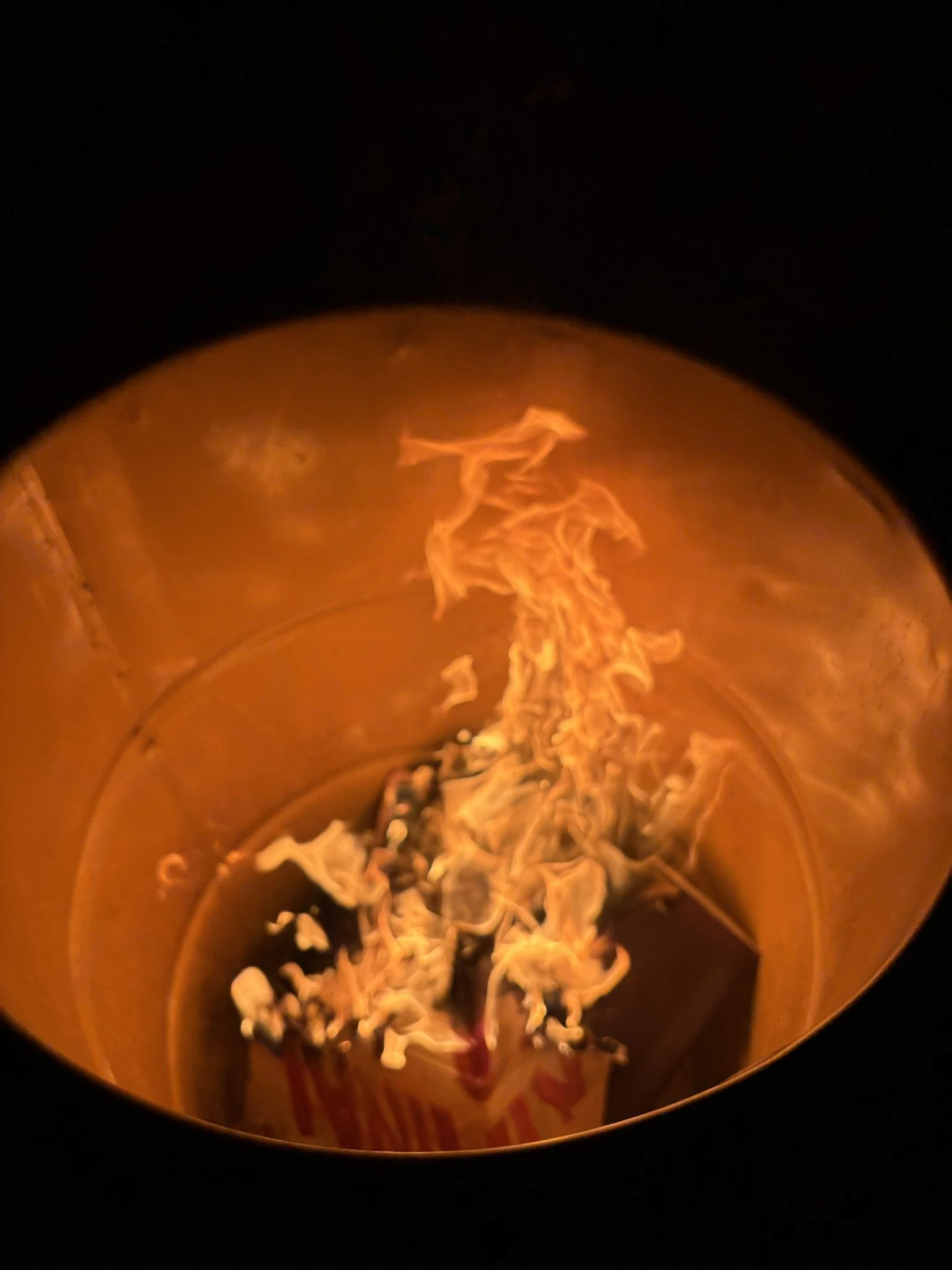
2026
What is Consciousness Raising?
A Tool for Feminists
The Women’s Liberation Movement in the 1960s inspired women to gather and share their struggles with sexuality, domestic life, work, and more. Through these conversations, they realized that their “personal problems” were, in fact, shared experiences in a system of male dominance—in other words, they were manifestations of systemic problems. These women then worked to develop a way of analyzing political problems that is relevant to women and based on information they could trust is true, adopting and adapting similar techniques from the Civil Rights Movement and Chinese Revolution to ultimately create the tool that they called “consciousness raising” (CR).
CR taught women that our own experiences are the most reliable source of information we need to understand the sex contradiction and formulate theory. CR encouraged women to deeply analyze their own lives and identify the root causes of women’s oppression, and through this they understood that the system of patriarchy was not an abstract force, but one that manifested daily in the most intimate spheres.
At TORCH, we will host multiple Consciousness Raising sessions each day!
Further reading:
“Consciousness-Raising: A Radical Weapon” by Kathie Sarachild (1973)
“Resistances to Consciousness” by Irene Peslikis (1969)
“About my Consciousness Raising” by Barbara Susan (1969)
“How to Start a Group” by Judith Brown of Gainesville Women’s Liberation (1969)
How does Consciousness Raising work?
In a group of women, each woman answers a question or set of questions as honestly and completely as possible. They are given an allotted amount of time so that each person can speak.
Participants answer from their personal experience, not what they read in a book or what they think are problems in general. It’s important to hear from women with a variety of different backgrounds.
Listen, learn, go off on tangents!
A note-taker records testimonies anonymously. Testimonies and conclusions should be shared so that other women can learn from your group’s observations!
After everyone has testified, there is time set aside for coming to conclusions.
All participants work together to pool and compare the experiences they heard about, paying special attention to contradictions between testimonies, trying to find the common root problem.
Identify actions to create change! Avoid individual solutions or merely offering advice.
Example CR questions:
“How have you felt most oppressed as a woman recently?”
“What has it meant for women in the group to earn their own money? What has it meant to your mother and her friends?”
“Discuss feminist issues that cut across racial and class lines, touching the lives of all women. Which of all these issues have you worked on or considered a priority?”
“Have you ever lived with a man? What did you like about it? What did you not like?”
“When did you begin to make the connection between your own experiences and the experiences of other women?”
Consciousness Raising at TORCH 2026:
Use the info linked here to run your own CR sessions!
Total Woman Victory’s Statement
on the Events of October 9–11, 2026
In the days surrounding TORCH 2026, Total Woman Victory (TWV) became the target of an organized campaign of harassment, intimidation, and threats intended to prevent women and girls from gathering for an independent radical feminist conference. In the aftermath, narratives have circulated that obscure the sequence of events, misrepresent the conduct of those involved, diminish the extraordinary efforts women made to ensure that our gathering was not disrupted, and continue to put women and children in harm’s way.
We are releasing this statement to establish the chronology of the conference and clarify the circumstances under which it proceeded.
On Friday, September 25th, our original venue Worcester State University (WSU) sent TWV a security addendum requiring 16 police details from WSU Campus Police, Worcester City Police, and the Sheriff’s Department to be stationed inside and outside the venue from 8 AM to 8 PM because of repeated threats of violence and intimidation. This was quoted at $38,350.00. We were given until Wednesday, September 30th (three business days later) to sign the addendum and submit payment. The financial burden was unfeasible for our organization. We could not responsibly commit to a security expenditure of that scale and also disagreed with the risk-level assessment of the university organizers. We therefore sought alternative arrangements.
On October 2, we contacted another venue, toured the space, and paid the full rental cost that same day. On Friday, October 9th, we arrived at this venue at approximately 8 AM to set up for the conference. At around 9:45 AM, fifteen minutes before the conference was scheduled to open, a woman working for the venue pulled our organizer, Sathi Patel, aside and informed her that employees had received notice of threats to disrupt by all means necessary and that this venue could no longer host the event because of this.
We immediately began contacting alternative venues, but they ultimately declined to host the conference because of threats of violence.
We quickly moved our programming to Implacable Books. Women organized themselves amid the chaos—they immediately self-organized rentals for chairs, rearranged seating, cleaned the bookstore to make more room, and communicated information to one another as we worked to continue the day. We held three sessions with the time remaining and, by Friday evening, collectively decided to continue the conference at the bookstore for the rest of the weekend. There were no disruptions to the conference on Friday.
On Saturday morning, attendees arrived at 10 AM, and we began the program. To protect the privacy and safety of attendees, women and girls covered all windows and doors that looked into the building.
That morning, information about a planned disruption at the bookstore began circulating publicly. The disrupters announced plans to arrive at approximately 2 PM. At around 2:30 PM, because they had not yet appeared, we held a security meeting. We collectively decided not to engage with the anticipated disrupters and to continue the conference as planned.
Approximately thirty disrupters gathered at Crompton Park (two blocks away) before around fifteen men + their allies marched their way to the bookstore at around 2:40 PM.
Children in the neighborhood, who had been spending time around the bookstore, approached the disrupters in conversation, asking who they were and why they were there. These children have developed a meaningful connection to the bookstore and have helped make it a living community space. According to what we were told by those present, disrupters responded aggressively, striking phones out of children’s hands as they recorded and hitting their bicycles as they rode alongside the group. The children are okay.
Inside the bookstore, six trusted women worked together to barricade the entrance as disrupters pulled at the door in an apparent attempt to get inside. Two conference sessions were taking place simultaneously. Women and girls were inside participating in the conference. Our priority was to protect everyone in the building and prevent the disruption from reaching them altogether.
The building’s brick construction and insulation meant that participants inside could not hear what was happening outside. We were focused on holding the entrance and maintaining the safety of the people inside.
Police had been notified in advance of the planned disruption, and we had communicated concerns about anticipated disruptions to the conference throughout the preceding week. At approximately 2:38 PM, police were called to respond. By around 2:50 PM, when several women went outside to speak with officers, three disrupters were already in handcuffs. Police moved the disrupters away from the premises and informed us that we should call again if they returned.
The conference continued. We completed a full day of programming, including the Freedom Trash Can, despite the attempted disruption outside our doors.
We want to be unequivocal about what this required of the women inside. While disrupters attempted to force their way into the space, women were simultaneously responsible for protecting attendees, maintaining the entrance, communicating with one another, and preserving the program. The fact that the sessions continued does not make the threats launched by misogynists insignificant. It reflects the resolve of the women who refused to let intimidation determine whether we could meet.
On Sunday, attendees returned at 10 AM, and we immediately resumed programming. We held eight sessions and continued all the way until about 11 PM.
There was no further disruption at the bookstore on Sunday. At approximately 1:05 PM, rape alarms were thrown onto the roof. They were unheard by participants inside and we silenced them and continued our program.
TORCH proceeded because women made it proceed. TORCH was convened to bring women together across generations for feminist theory, organizing, consciousness-raising, and history—and that is exactly what we did and will continue to do. We invited women from across North America to learn from and alongside our elders and younger sisters, to examine the roots and modern iterations of women’s oppression, and to strengthen an independent feminist movement.
We reject the suggestion that the burden of preventing intimidation should fall entirely upon the women being targeted. TWV was forced to navigate prohibitive security costs, the intimidation of local community organizations and institutions that allowed us to host critical conversations, the possibility of physical violence, and the responsibility of protecting conference attendees, all while trying to deliver the very program we had spent months preparing because of violent misogynists.
The events surrounding TORCH were a result of the fully socially-condoned harassment campaign directed at our organizers by a rapist and his allies. Sathi Patel has obtained a harassment prevention order from Worcester District Court against Andrew Saltzberg, whom we identify as the owner of the online accounts @snuff.the.torch and @matapacosworcester. As of the time of this statement, the order has not been served because of an old address on file.
We are grateful to every woman who traveled to Worcester, every woman who spoke, every woman who listened, every woman who helped make room, and every woman who contributed to keeping the conference alive. We are grateful to the community members whose space and labor made it possible to continue. The conference belongs to all those who helped sustain it.
We will not allow the hostility directed at us to dictate the future of feminist organizing. We will continue to build spaces for feminist political education, historical study, and intergenerational exchange. We will continue to insist that women have the right to assemble, to speak, to disagree, to dissent, and to organize without intimidation.
Our commitment to women’s liberation is not contingent upon the approval of our political opposition. Nor will it be extinguished by men’s attempts to frighten us out of gathering.